
Most beauty entrepreneurs lose thousands of Euros because they can't tell the difference between a label and a formula. Choosing white labeling might seem like the easiest route to market, but without understanding the trade-offs in control and minimum order quantities, you could be setting your brand up for a growth ceiling you can't break through. It's frustrating to navigate the complex web of EU regulations and CPNP notifications while trying to build a premium brand identity.
You deserve a clear, result-oriented strategy that doesn't leave you guessing about your profit margins. We know you're looking for a way to scale efficiently without drowning in technical jargon or unmanageable overhead. This guide helps you master the critical differences between these two models so you can choose the most profitable manufacturing path for your business.
We'll break down the cost vs. control trade-off and explain how to manage compliance costs, which often range from €1,000 to €3,000 per product in the EU. By the end, you'll have a clear decision on your manufacturing model and know exactly how to find a reliable partner to launch your next bestseller.
Key Takeaways
- Learn how to distinguish between pre-formulated products and exclusive custom lines to choose the manufacturing path that fits your budget.
- Discover why white labeling offers the fastest time-to-market and lowest initial investment for professionals wanting proven success.
- Gain a competitive edge by understanding how private labeling allows for unique ingredient control and specific skin concern targeting.
- Navigate complex EU cosmetic regulations and CPNP requirements to ensure your brand is fully compliant and market-ready.
- Evaluate the trade-offs between MOQs and profit margins to determine which model maximizes your long-term return on investment.
What is White Labeling and How Does it Differ from Private Labeling?
Understanding manufacturing jargon is the first step toward launching a successful beauty line. While many use the terms interchangeably, the distinction between these models determines your speed to market and your long-term brand value. To get a baseline understanding, you can look at What is a white-label product as a general concept. In the beauty industry, white labeling refers to a manufacturer's pre-existing, dermatologically tested formula that is sold to various retailers. These retailers then apply their own branding and packaging. Private labeling, however, involves creating a unique formula or making significant modifications to a base recipe that remains exclusive to your brand.
The confusion often lies in the legal responsibility. In the EU, regardless of which model you choose, the 'Responsible Person' must ensure the product complies with Regulation (EC) No 1223/2009. This includes CPNP notification and safety assessments. While the manufacturer provides the safety data for white label products, the brand owner still carries the market responsibility. This includes managing safety assessment costs, which typically range between €1,000 and €3,000 per product depending on the complexity of the ingredients.
The Core Concept: Speed vs. Customization
White label products are essentially 'off-the-shelf' solutions. They're ideal for salon owners or entrepreneurs who want to start selling immediately. Since the R&D and testing are already complete, you skip the months of laboratory trials. Private label products require a bespoke development cycle. This path is for brands that want to target specific skin concerns or follow strict ethical standards like vegan or PFAS-free certifications. While white labeling wins the sprint for a quick launch, private labeling allows you to build a marathon-winning brand with a unique selling proposition (USP) that competitors can't easily copy.
Formula Ownership and Intellectual Property
Who owns the 'recipe'? This is the most critical question for your brand's valuation. In a white labeling arrangement, the manufacturer retains 100% of the formula's intellectual property. You're effectively renting the right to put your name on their work. This carries the risk of 'brand clones' where another business sells the exact same serum in a different bottle. Private labeling offers a layer of protection. By developing a custom formula, you ensure that your 'hero product' remains unique to you. If you ever plan to sell your company, owning your formulas significantly increases the acquisition price. It prevents competitors from undercutting you with the same product under a different label.
The Benefits of White Labeling: Fast Entry with Proven Beauty Formulations
Speed is the ultimate currency in the beauty industry. While custom development offers uniqueness, white labeling provides the fastest path to profitability. This model allows you to skip the expensive and time-consuming Research & Development (R&D) phase. Instead of spending months testing pH levels or preservative efficacy, you leverage formulas that have already achieved proven market success. These products have undergone rigorous stability testing and dermatological evaluations, ensuring they meet the EU Cosmetic Regulation standards before you even place your first order.
By eliminating lab fees and formulation trials, you can redirect your capital toward brand storytelling and high-impact marketing. Many entrepreneurs find that choosing the right business model at the start determines whether they launch in weeks or years. For most startups, the priority is generating cash flow quickly. Using pre-vetted formulas is the most efficient way to achieve that goal without the technical headaches of chemistry.
Why Salons Choose White Labeling
Salon owners are uniquely positioned to benefit from this model. You already have a captive audience of beauty lovers who trust your expertise. White labeling allows you to turn a one-time service into recurring retail revenue with minimal overhead. High-demand categories like brow oils, lash cleansers, and hydrating serums are perfect for this. By offering a premium product that complements your in-salon treatments, you increase your profit margins. It is a low-risk method to test if your clients are ready for a full retail line before you commit to more complex Private Label Manufacturing options.
Lowering the Barrier to Entry: MOQs and Timelines
The biggest fear for new brands is often the high Minimum Order Quantities (MOQs). In the European market, white label MOQs are significantly more accessible, typically ranging from 72 to 500 units. This is a fraction of the thousands of units usually required for custom manufacturing. This lower threshold makes it possible to launch a professional line without a massive capital outlay.
Timing is equally critical. A custom formula can take 6 to 12 months to move from the lab to the shelf. In contrast, white label solutions can be ready for shipment in just a few weeks. When you work with a partner focused on efficiency, you benefit from a same-day shipment mentality. This ensures your stock is always replenished and your customers aren't left waiting. You focus on the sales while the manufacturer handles the heavy lifting of production and compliance.
Private Labeling: Creating a Unique Signature for Your Professional Line
If your goal is to build a legacy brand with a distinct competitive advantage, private labeling is the strategic choice. While white labeling serves as an excellent foundation for rapid growth, private labeling offers the level of control required to dominate a niche market. This model allows you to define your Unique Selling Proposition (USP) by engineering formulas that address specific skin concerns or adhere to strict ethical standards, such as being 100% vegan or free from banned substances like PFAS. By owning the formula, you ensure that your professional clients can only get your specific results from you, cementing brand loyalty that is difficult to break.
Brand equity is built on exclusivity. When you develop a custom line, you are creating a sellable asset. Unlike a rebranded generic product, a custom-formulated line has a unique "signature" that adds significant value to your business valuation. If you ever decide to exit or scale your beauty empire, owning the intellectual property of your hero products becomes your most powerful bargaining chip. It prevents your brand from becoming just another "clone" in a saturated market. Total control is the goal.
The Custom Formulation Process
The journey from concept to chemist is rigorous and requires a commitment to quality. It begins with a detailed brief where you specify active ingredients, texture, and scent. Stability testing is a critical phase in custom production. It ensures the product remains effective and safe throughout its shelf life, even when exposed to varying temperatures. For instance, incorporating specialized high-performance ingredients, similar to the quality standards seen in NOSSA Amsterdam brow henna, requires precise microbial balancing. You aren't just buying a product; you are overseeing a technical development cycle that guarantees a premium finish.
Advanced Packaging and Brand Identity
Private labeling allows you to move beyond the aesthetic limitations of standard white labeling. You can invest in bespoke packaging solutions like airless pumps, sustainable glass, or custom-molded components that reflect your brand’s professional positioning. This level of detail significantly boosts the perceived value of your products. While it requires a higher upfront investment for design and branding, the result is a cohesive brand identity that stands out on any professional shelf. High-quality packaging doesn't just look better. It protects the integrity of your custom formula and communicates excellence to your B2B partners and end consumers alike.
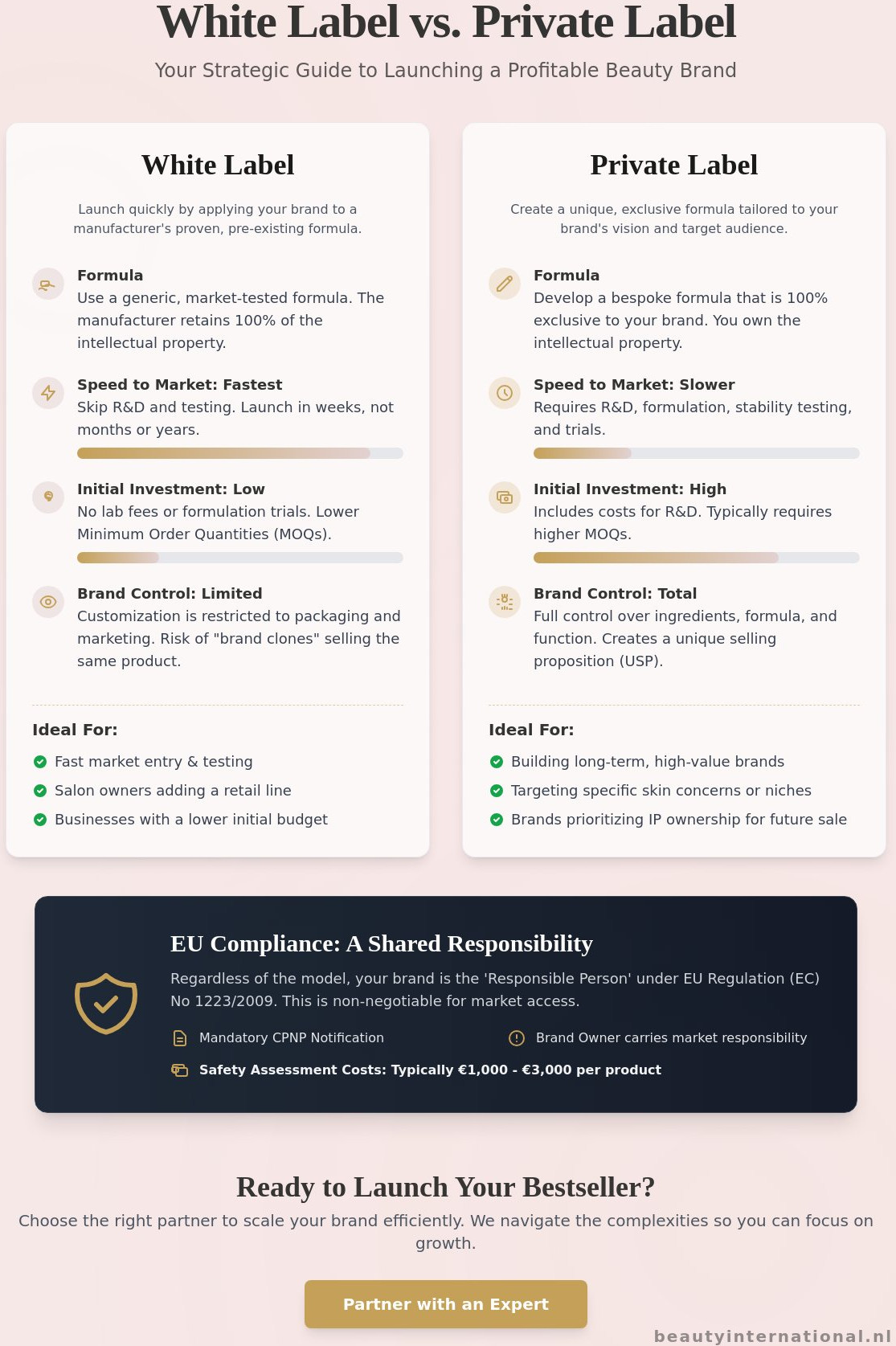
Comparison Framework: MOQs, Timelines, and EU Compliance (CPNP)
Choosing between manufacturing models requires a cold analysis of your capital and your clock. White labeling is the undisputed winner for speed; it allows you to bypass the R&D phase and go from concept to shelf in as little as four weeks. However, this convenience comes with a higher per-unit cost. Private labeling, while requiring a "marathon" mindset with development cycles often exceeding six to twelve months, rewards the patient entrepreneur with lower per-unit manufacturing costs once production scales. Your decision hinges on whether you need immediate cash flow or long-term margin optimization.
The scalability of your brand also depends on your logistics partner. A model that works for a single salon might fail when you transition to national distribution. For those ready to move beyond small batches, Private Label Manufacturing provides the infrastructure to support large-scale retail contracts. Success in the beauty industry isn't just about the formula; it is about having a supply chain that can handle the transition from 100 units to 10,000 without a dip in quality.
Navigating EU Cosmetic Regulations
Compliance is non-negotiable in the European market. Every product must be registered on the Cosmetic Product Notification Portal (CPNP) before it can be legally sold. Under Regulation (EC) No 1223/2009, you must also maintain a Product Information File (PIF) for every SKU. In a white label agreement, the manufacturer usually holds the base PIF data, but you remain the Responsible Person (RP) for your specific branded version. Partnering with a Netherlands-based expert like Beauty International simplifies this process. Dutch quality standards and efficient logistics ensure that your documentation meets strict EU requirements, protecting your brand from costly legal hurdles or product recalls.
The Profitability Equation
Calculating your Return on Investment (ROI) requires looking past the initial invoice. For white labeling, your initial setup fees are minimal, but your gross margins are capped by the manufacturer's fixed pricing. With private labeling, you must account for safety assessment costs, which typically range between €1,000 and €3,000 per product. Industry data suggests that while private label models require more upfront capital, they typically yield higher net profit margins than white-label products once production volumes surpass the 1,000-unit threshold. Many successful brands start with white label products to generate initial revenue and then transition to custom formulations as their customer base grows, allowing them to reinvest profits into unique intellectual property.
Partnering for Success: How Beauty International Scales Professional Brands
Beauty International Europe BV serves as the strategic bridge between a vision and a market-ready brand. We aren't just a supplier; we're an ambitious partner for beauty entrepreneurs who demand efficiency and results. Our Dutch roots ensure a commitment to high standards, while our international orientation allows us to scale brands across the European market. Whether you're starting with white labeling to test the waters or ready for full-scale custom production, we provide the infrastructure needed to succeed in a competitive landscape.
Our business model is built on a "B2B PROFESSIONALS ONLY" philosophy. This focus is critical for maintaining your brand's high-end salon positioning. We understand that professional-grade products require a level of quality and consistency that mass-market cosmetics can't match. From distributing global leaders like NOSSA Amsterdam brow henna to managing complex manufacturing projects, our goal is to maximize your win margin while delivering premium results for your clients.
Our End-to-End Manufacturing Solutions
We handle the technical complexities of production so you don't have to. Developing a new beauty product shouldn't feel like a chemistry experiment for a brand owner. Our team manages the formulation expertise and microbial testing required for EU compliance. This freedom allows you to spend your energy on marketing and building your "Beauty Lovers" community. We bring innovative beauty concepts to life with a premium finish that stands out on any professional shelf. Our design and packaging support ensures that your brand’s visual identity matches the high quality of the formula inside.
Join the Network of Successful Beauty Brands
Logistics and speed are where we truly excel. In the fast-paced beauty industry, out-of-stock items mean lost revenue. We operate with a "same-day shipment" mentality for orders placed before 15:00. This efficiency is a massive advantage for your wholesale partners and distributors across Europe. It ensures a steady supply chain and keeps your brand's momentum high. B2B professionals trust Beauty International because we combine professional-grade product quality with reliable, modern distribution methods.
Building a brand is a marathon, but the right partner makes the sprint to market much easier. If you're ready to stop navigating manufacturing jargon and start seeing results, it's time to leverage our expertise. Launch your own professional beauty brand with Beauty International today!
Scale Your Brand with Confidence
Choosing between white labeling and private labeling is a strategic decision that shapes your brand's identity and future profitability. If you're looking for a fast, low-risk entry into the market with proven formulas, the white label model is your best sprint toward immediate cash flow. For entrepreneurs ready to build a unique signature and long-term brand equity, private labeling offers the exclusivity and control that professional clients demand. Total control over your formula is the key to building a sellable asset.
Success in the European market requires more than just a high-quality product. It demands strict CPNP compliance and efficient logistics. As the official provider of NOSSA Amsterdam and specialists in EU manufacturing, Beauty International Europe BV handles the technical complexities for you. We maintain a strict B2B professional focus and offer same-day shipment for orders placed before 15:00 to keep your business moving at peak efficiency.
Stop overthinking the manufacturing process and start building your legacy. Start your Private Label journey with Beauty International Europe BV and launch a brand that beauty lovers will trust for years to come.
Frequently Asked Questions
What is the main difference between white labeling and private labeling?
The primary difference between white labeling and private labeling is formula ownership and customization. White label products use pre-existing, proven formulas sold to multiple brands, while private label products are custom-developed and exclusive to your business. This means private labeling allows for unique ingredient control, whereas white labeling focuses on speed to market.
Is white labeling legal for cosmetics in the European Union?
Yes, white labeling is completely legal in the European Union as long as the products comply with EU Cosmetic Regulation (EC) No 1223/2009. Every branded product must have a designated Responsible Person (RP) and must be notified on the CPNP. It's essential to ensure your manufacturer provides all necessary safety data for your Product Information File (PIF).
How much does it cost to start a private label beauty brand?
Starting a private label brand requires a higher initial investment compared to other models due to R&D and regulatory fees. In the EU, safety assessments for cosmetic products typically cost between €1,000 and €3,000 per product. These costs vary based on the complexity of your ingredients and the number of formulations you plan to launch.
What is the minimum order quantity (MOQ) for white label cosmetics?
Minimum Order Quantities (MOQs) for white labeling in the beauty industry typically range from 72 to 500 units. This lower threshold makes it an ideal choice for salon owners who want to launch a professional retail line without committing to thousands of units. It allows you to test market demand with a smaller financial risk.
Do I need a chemist to start my own private label skincare line?
You don't need to hire your own chemist because a professional manufacturing partner handles the technical laboratory work for you. Partners like Beauty International provide the formulation expertise and microbial testing required to bring your vision to life. You focus on the brand identity and sales while the experts manage the chemical engineering and stability trials.
What is the CPNP and why is it important for my brand?
The Cosmetic Products Notification Portal (CPNP) is a mandatory online system for all cosmetic products placed on the EU market. It's important because it provides poison centers and market surveillance authorities with immediate access to product information. Without a CPNP notification, your beauty products cannot be legally sold or distributed within the European Union.
Can I change the formula of a white label product?
No, you typically cannot change the core formula of a white label product as these are pre-set and already safety-tested. If you want to add trending active ingredients or exclude specific allergens, you should choose a private label model instead. Private labeling gives you the flexibility to modify textures, scents, and ingredient profiles to create a unique signature line.
How long does it take to launch a private label beauty product?
Launching a private label beauty product generally takes between six and twelve months from concept to delivery. This timeline accounts for custom formulation, stability testing, and mandatory EU safety assessments. If you need a faster solution, white label products can often be launched in just a few weeks since the R&D phase is already complete.