
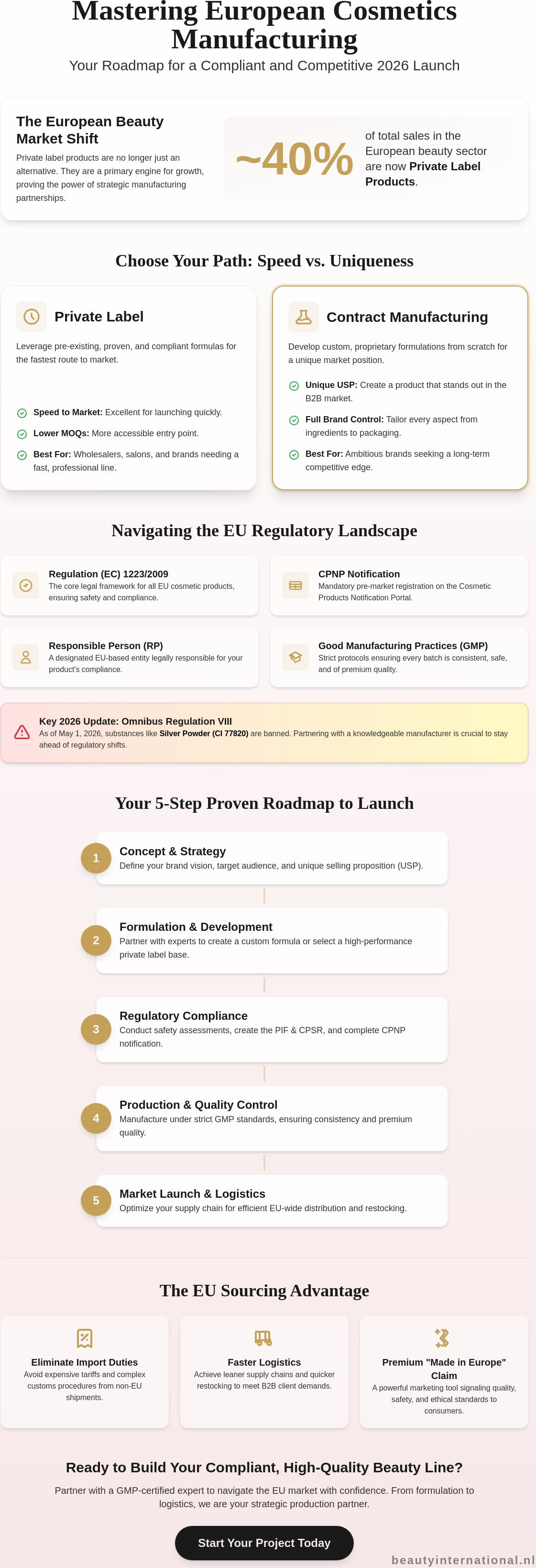
Did you know that private label products now command nearly 40% of total sales in the European beauty sector? This surge proves that professional contract cosmetics manufacturing Europe is no longer just an alternative; it's the primary engine for brands that want to scale fast. If you've felt the pressure of high MOQs or the headache of inconsistent quality from non-EU suppliers, you aren't alone. Most ambitious beauty entrepreneurs agree that the biggest hurdle isn't the creative vision. It's the technical execution within the strict EU regulatory framework.
This guide promises to give you total clarity on how to master European production for 2026. You'll learn how to handle the latest CPNP compliance shifts, including the May 2026 Omnibus Regulation VIII bans on substances like silver powder. We'll preview the essential steps to secure a premium, market-ready line that rivals top global brands without the typical supply chain friction. From understanding the role of a Responsible Person to optimizing your logistics for the Dutch and wider EU markets, you're about to build a more efficient and compliant business.
Key Takeaways
- Understand the strategic shift from basic white label products to full-scale contract manufacturing to secure a competitive edge in the 2026 beauty market.
- Navigate the essential requirements of Regulation (EC) No 1223/2009 and the CPNP portal to ensure your cosmetic line remains fully compliant and market-ready.
- Evaluate whether private label speed or custom formulation uniqueness best serves your brand's long-term B2B scaling goals.
- Follow a proven five-step roadmap for contract cosmetics manufacturing Europe to move efficiently from initial concept to high-quality production.
- Identify how to vet production partners for GMP certification and professional-grade quality to rival the world’s leading beauty brands.
Defining Contract Cosmetics Manufacturing in the European Market
At its core, contract cosmetics manufacturing Europe is a strategic B2B partnership where a specialized producer handles the formulation, filling, and packaging of products for your brand. It's the engine behind the world’s most successful beauty labels. You bring the brand vision and market strategy; the manufacturer provides the laboratory, the production facility, and the regulatory expertise. This model allows ambitious beauty brands to scale without the massive capital investment required to build and maintain a factory.
In 2026, we’re seeing a decisive shift away from basic 'White Label' solutions toward sophisticated 'Contract Manufacturing'. Yesterday's entrepreneurs were often satisfied with generic, off-the-shelf formulas. Today's market leaders demand more. They want high-performance ingredients and unique selling points that stand out in a crowded digital landscape. To meet these demands, every reputable partner must strictly follow Good Manufacturing Practices (GMP). These protocols ensure that every batch is consistent, safe, and of premium quality. It's why Europe remains the global gold standard for cosmetic safety and innovation.
A vital part of this relationship is the 'Responsible Person' (RP). Under EU Regulation (EC) No 1223/2009, every cosmetic product must have a designated RP based within the Union. This person or entity is legally responsible for ensuring the product complies with all safety rules. When you work with a professional contract partner, they help you navigate these legal waters, ensuring your Product Information File (PIF) and safety reports are always audit-ready.
Contract Manufacturing vs. Private Label: Which is for you?
Choosing between these two paths depends on your timeline and budget. Private Label is the fastest route to market. You use pre-existing, proven formulas that are already tested and compliant. It's an excellent choice for wholesalers or salon owners who want to launch a professional line quickly. Contract Manufacturing is the better fit if you need a unique USP. This involves developing custom formulations from scratch. While it takes more time and investment, it gives you a distinct edge in the 'B2B Professionals Only' segment where efficacy is everything.
The Economic Advantage of Sourcing Within the EU
Sourcing your production within Europe isn't just about prestige; it's about your bottom line. You eliminate expensive import duties and the complex customs procedures that often delay non-EU shipments. For businesses based in the Netherlands, this translates to leaner supply chains and more efficient logistics. A 'Made in Europe' claim is a powerful marketing tool that signals premium quality and ethical standards to global consumers. Plus, keeping production local reduces your carbon footprint and enables faster restocking, supporting the high-speed 'same day shipment' expectations of modern B2B clients.
The Regulatory Landscape: CPNP and EU Safety Standards
Entering the EU market requires more than just a great formula. It demands total adherence to Regulation (EC) No 1223/2009, which serves as the definitive legal framework for all cosmetic products. If you're exploring contract cosmetics manufacturing Europe, you'll quickly find that compliance isn't a 'nice-to-have'. It's the ticket to entry. Every product must have a comprehensive Cosmetic Product Safety Report (CPSR) and a Product Information File (PIF) that remains accessible for ten years after the last batch is sold. These documents prove your line is safe for human health under normal use.
The Cosmetic Products Notification Portal (CPNP) is your next critical stop. This centralized system notifies all EU member states about your product's presence. While the portal itself doesn't charge a fee, the preparation behind it involves toxicological assessments, stability testing, and challenge tests that require significant expertise. As of May 1, 2026, the Omnibus Regulation VIII has introduced even stricter prohibitions, banning substances like perboric acid and silver powder (CI 77820) in most applications. Staying ahead of these shifts is what separates professional brands from those that face sudden market removals and lost revenue.
Navigating the CPNP Registration
Notification must happen before a single unit hits the shelf. Your 'Responsible Person' handles this, ensuring the labels, ingredients, and safety data match the digital filing. The cost of skipping this step is high. We're talking about heavy fines, immediate product recalls, and irreparable brand damage. When you partner with an expert in Private Label Manufacturing, they handle this heavy lifting, allowing you to focus on sales while they manage the legal complexity and dossier management.
Ingredient Transparency and 'Clean Beauty' Standards
2026 marks a turning point for transparency. Fragrance allergen labeling has expanded from 26 to over 80 declarable substances. This means your ingredient lists will get longer and more specific. Additionally, France's ban on PFAS in cosmetics, effective January 1, 2026, signals a wider EU trend toward 'forever chemical' elimination. Formulating for the modern professional means meeting these 'clean' standards without losing the high-performance results that salon clients expect. It's about achieving that premium finish while remaining 100% compliant with the latest ISO 22716 standards and Good Manufacturing Practices.
Custom Formulation vs. Private Label: Choosing Your Path
Deciding between custom and private label production is the most critical commercial choice you'll make. It dictates your budget, your timeline, and your ultimate market position. When you look for contract cosmetics manufacturing Europe, you must align your production method with your specific business goals. Are you trying to capture a trend before it fades, or are you building a legacy brand with a proprietary secret sauce? Both paths offer distinct advantages, but they require different levels of capital and patience.
Salon-grade formulas are 'Professional Only' for a reason. They carry higher concentrations of active ingredients than mass-market products, delivering the immediate results that B2B clients demand. This efficacy is what allows you to command higher margins. Whether you're selling to other professionals or high-end consumers, the 'premium' look of your packaging must match the performance of the liquid inside. Glass bottles, airless pumps, and high-quality embossing don't just look better; they protect the formula and justify a higher price point on the shelf.
Minimum Order Quantities (MOQs) act as the gatekeepers of your cash flow. In the European market, MOQs can vary wildly. Private label options often allow you to start with as few as 50 to 100 units per SKU. Custom formulations, however, usually require 1,000 to 5,000 units to offset the costs of R&D and machine setup. You need to balance the desire for a unique product with the reality of your storage capacity and initial investment.
The Case for Private Label Efficiency
Speed is the primary weapon here. By choosing private label, you leverage formulas that have already passed the rigorous EU regulatory framework for cosmetics. You don't have to wait months for stability testing or challenge tests. This is the ideal route for salons wanting to launch their first branded brow products or skincare line. You get a proven best-seller with your logo on it, allowing you to enter the market in weeks rather than years.
Developing Custom Formulations
Custom formulation is for the brand that wants total control. The R&D process starts in the lab, where chemists turn your concept into physical samples. You'll go through multiple rounds of feedback until the texture, scent, and performance are perfect. A key factor here is intellectual property. You should always clarify who owns the final formula. While it takes longer to scale from small batches to mass distribution, owning a unique USP makes your brand much more attractive to investors and long-term wholesale partners.
5 Steps to Launching Your Cosmetic Line in Europe
Launching a successful brand requires a roadmap that balances creative ambition with cold, hard logistics. In a market where 27% of sales now happen online, your speed to market is just as vital as your formula. To navigate the complexities of contract cosmetics manufacturing Europe, you must follow a disciplined process that eliminates guesswork and secures your investment. This five step blueprint ensures your brand transitions from a concept to a high margin reality without the typical pitfalls of EU production.
- Market Research & Concept: Identify the specific gap in the B2B or retail market. Professionals in the Netherlands often look for high performance products that save time during treatments, such as fast acting brow solutions.
- Partner Selection: This is the most critical hurdle. You need a manufacturer that offers GMP certification and understands the specific demands of both salon professionals and retail consumers.
- Sample Approval: Never settle for the first iteration. Test for texture, scent, and professional efficacy. A premium formula must feel superior to mass market alternatives to justify its price point.
- Regulatory Filing: Finalize your Product Information File (PIF) and complete the CPNP notification. This is the final legal gate before your products can be sold in any EU member state.
- Logistics & Launch: Utilize the 'Dutch Gateway'. The Netherlands is the logistical heart of Europe, offering the fastest routes to major markets like Germany, France, and Scandinavia.
Vetting Your Manufacturing Partner
Your manufacturer is more than a supplier; they're a strategic ally. Ask direct questions about their production capacity and lead times. A partner who understands the 'B2B Professionals Only' segment will know that salon owners can't afford out of stock situations. Choosing a partner with Dutch brand expertise combined with global production capabilities gives you a unique advantage. It ensures your brand carries the prestige of European quality while maintaining a competitive edge in innovation. If you want to start with a proven partner, explore our Private Label Manufacturing options to see how we handle these complexities for you.
Optimizing Your Supply Chain
In 2026, efficiency is your greatest asset. We operate with a 'same day shipment' mentality because we know that inventory delays kill growth. By leveraging a Netherlands based hub, you can dramatically reduce lead times for Northern European distribution. This strategic positioning allows for leaner inventory management, meaning you don't have to tie up all your cash in massive stock piles. Focus on a partner who can scale with you, moving from small professional batches to mass distribution as your brand gains traction.
Why Beauty International is Your Strategic Production Partner
Choosing a partner for contract cosmetics manufacturing Europe is a decision that defines your brand's future. Beauty International Europe BV isn't just a manufacturer; we're a result-oriented extension of your business. We understand that in the professional beauty sector, "good enough" doesn't exist. You need products that perform flawlessly under the pressure of a busy salon environment while maintaining the high profit margins your business deserves. Our approach is direct, professional, and focused on the commercial success of our B2B partners.
Our track record speaks for itself. We're the official providers of NOSSA Amsterdam brow henna, a brand that has become a benchmark for quality in the professional eyebrow industry. This success isn't accidental. It's the result of combining innovative formulas with a deep understanding of what beauty professionals actually need. Whether it's the precision of brow products or the groundbreaking technology found in SPOT MY UV stickers and BikiniZone, we consistently deliver products that set new market standards. We don't just follow trends; we manufacture the tools that define them.
The 'Dutch Quality' Standard
We combine Dutch efficiency with high-end global manufacturing expertise to give you the best of both worlds. This means you get the logistical advantage of a Netherlands-based hub alongside formulas that rival the world's most exclusive labels. Our portfolio ranges from traditional professional cosmetics to innovative UV detection technology, proving our versatility across different market segments. We speak the language of beauty professionals because we are part of the industry. This direct B2B support ensures that your specific needs aren't lost in translation during the production process.
Start Your Private Label Journey Today
Success in the beauty industry requires a partner who can handle the technicalities so you can focus on your brand's growth. We help you navigate the complexities of CPNP and EU compliance effortlessly, ensuring your products are market-ready without the regulatory headaches. Our solutions are flexible, catering to both boutique professional salons and large-scale wholesalers who need a reliable supply chain. We're committed to your win-win margin, providing premium products that your customers will love and your accountants will appreciate. Don't let your vision stay on the drawing board. Contact Beauty International for your private label consultation and let's build your brand together.
Future-Proof Your Cosmetic Brand for 2026
Mastering the European beauty market requires a perfect balance of regulatory precision and commercial speed. You've seen how staying ahead of CPNP requirements and shifting from basic white labels to strategic contract cosmetics manufacturing Europe can secure your brand's longevity. By choosing a partner that understands the nuances of professional grade formulas, you ensure your products don't just sit on shelves but deliver the high performance results B2B clients demand.
Whether you're looking for the efficiency of private label or the uniqueness of custom development, the right choice depends on your specific scaling goals and cash flow management. Beauty International stands ready as your expert ally. As the official provider of NOSSA Amsterdam and specialists in complex CPNP compliance, we maintain a strict B2B professional focus to ensure your success in the Dutch and wider EU markets. We don't just make products; we build profitable legacies.
Don't let regulatory hurdles or supply chain friction slow your growth. It's time to turn your vision into a market-ready reality with a partner that values efficiency and quality as much as you do. Scale your beauty brand with Beauty International's professional manufacturing services and secure your place at the top of the industry today.
Frequently Asked Questions
What is the typical Minimum Order Quantity (MOQ) for contract manufacturing in Europe?
Typical MOQs for contract cosmetics manufacturing Europe start at 1,000 units for custom formulations. However, private label solutions are much more accessible for startups, often allowing orders as low as 50 to 100 units. This flexibility helps you manage cash flow without tying up capital in excessive stock. Larger wholesale batches usually require 5,000 units or more to maximize production efficiency and lower your per-unit cost.
How long does the CPNP registration process take for a new brand?
Preparing for CPNP registration generally takes between 12 and 24 weeks. While the actual notification on the portal is immediate, you can't file until your safety assessments and stability tests are complete. These scientific evaluations are mandatory under EU law. Working with an experienced partner ensures your Product Information File is ready before you launch, preventing delays that could stall your market entry.
Can I manufacture cosmetics in Europe if my business is based elsewhere?
You can manufacture in the EU from anywhere, provided you have a designated Responsible Person (RP) located within a member state. This RP acts as your legal representative and ensures the brand complies with all local safety standards. Many international brands choose a Dutch partner to serve as their gateway, simplifying logistics and regulatory oversight while maintaining their primary business operations outside of Europe.
What is the difference between an OEM and an ODM manufacturer?
OEM (Original Equipment Manufacturing) involves a factory producing a formula you've already developed. ODM (Original Design Manufacturing) means the manufacturer provides the formula and design, which you then brand. Most professionals looking for contract cosmetics manufacturing Europe prefer the ODM or private label model. It offers a faster route to market by using pre-tested, compliant formulas that are already optimized for professional performance.
How does Beauty International ensure the quality of its NOSSA Amsterdam products?
Quality for NOSSA Amsterdam is secured through rigorous dermatological testing and strict adherence to ISO 22716 standards. We combine Dutch efficiency with high-performance ingredients to ensure every batch meets professional salon expectations. Our focus on quality control means we monitor every step of the process, from raw material sourcing to the final packaging, ensuring a premium finish that justifies high profit margins for our B2B partners.
Do I need a separate safety assessment for every product in my line?
Yes, every unique formulation in your product line requires its own separate Cosmetic Product Safety Report (CPSR). Even minor changes in fragrance or active ingredients necessitate a new assessment to ensure user safety. While this adds to the initial development time, it's a non-negotiable requirement for legal market access. Safety assessors must evaluate each SKU individually to confirm it meets the latest toxicological standards.
What are the labeling requirements for cosmetics sold in the EU in 2026?
In 2026, labels must include the address of the Responsible Person and the expanded list of over 80 fragrance allergens. You must also clearly indicate any ingredients in "nano" form and provide a full INCI list. Labels must be legible and written in the language of the country where the product is sold. Accurate labeling is vital to avoid product recalls and ensure transparency for increasingly health-conscious consumers.
How can I scale my private label brand from a small salon to a wholesale distributor?
Scaling requires moving from small salon batches to high-volume bulk orders to improve your margins. Focus on building a robust wholesale network and optimizing your logistics through a central hub like the Netherlands. By leveraging same day shipment capabilities and professional-grade formulations, you can attract larger retail partners. Consistency in quality and a reliable supply chain are the two most important factors for transitioning from a local salon brand to a regional distributor.